
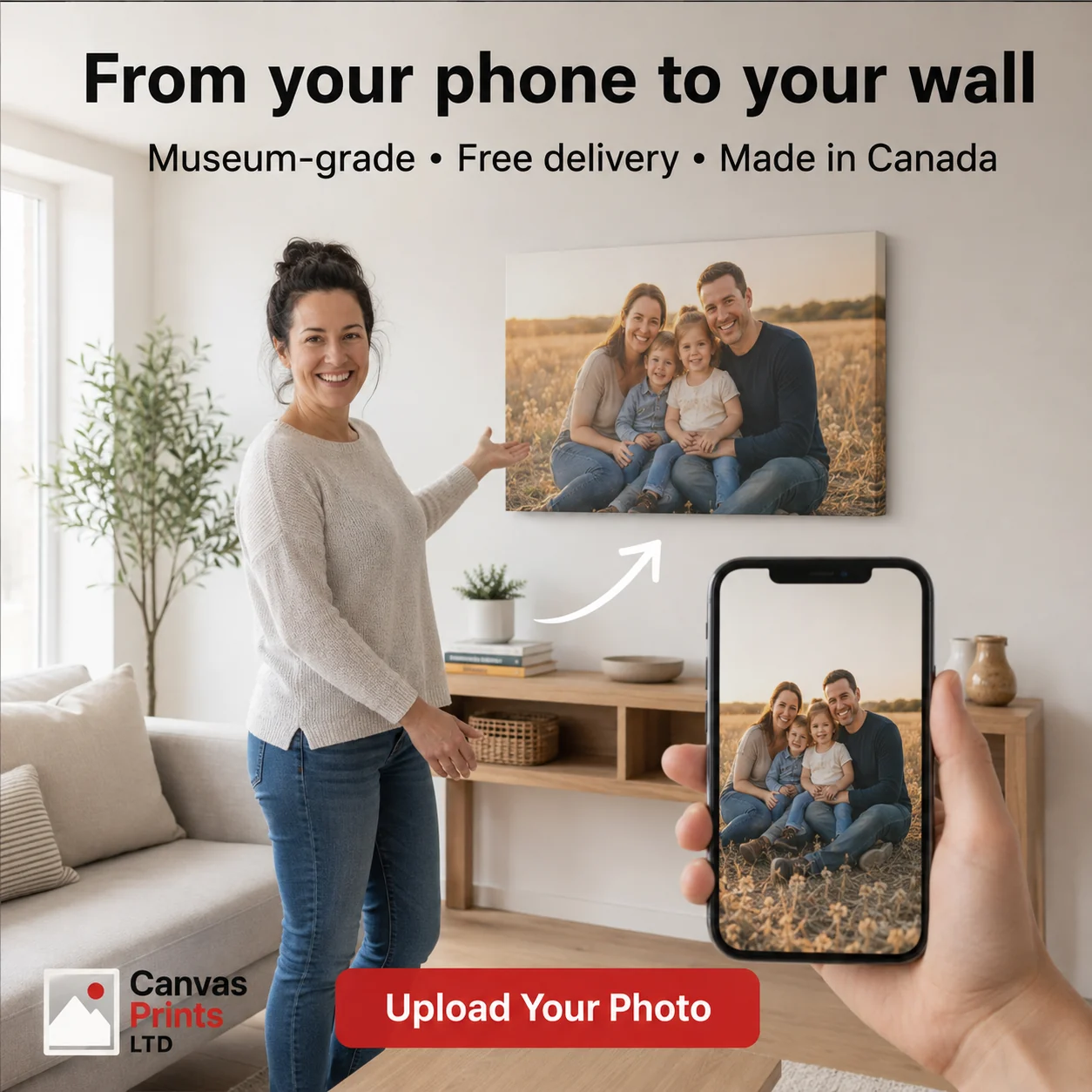
For Edmonton families, a canvas often begins with a photograph that already has a strong sense of place: a Jasper weekend, a river-valley walk, a graduation, a new baby, a pet, or several generations gathered in one room. The printing decision determines whether that image feels temporary or becomes part of the home.
Canadian shoppers are surrounded by online canvas offers, but the differences are rarely obvious in a thumbnail. Material, image preparation, stretcher construction, finishing, packaging, and communication all happen out of sight. The finished print reveals those choices at once.
This Edmonton guide approaches canvas prints Canada-wide from a practical family perspective. It focuses on what to verify before ordering, including the details that become important during a Prairie winter or when a large print must travel a long route.
A Quick Canvas Print Buying Checklist
- Confirm where the canvas is physically printed, stretched, finished, and packed.
- Ask whether the surface is cotton, polyester, or a blend.
- Use the original image file and check focus as well as resolution.
- Choose a ratio that preserves the composition before selecting dimensions.
- Review what happens to the image at wrapped edges.
- Compare the final configured price, not only the advertised starting price.
- Check packaging, delivery, support, and replacement procedures.
Canadian Production Should Be Easy To Verify
A company serving Canadians should be able to state where the product is printed and assembled. Marketing location and manufacturing location are not the same. Ask specifically where the image is printed, where the bars are made, and where the canvas is stretched and packed.
This transparency matters when an image needs review or a shipment needs help. A producer operating within Canada is easier to hold to a clear explanation of materials and process than a storefront that passes the order through several unknown facilities.
Why Canvas Fibre Changes The Result
Cotton has a familiar artist-canvas texture. It absorbs and reflects ink differently from a smooth synthetic textile, giving photographs a softer physical character while retaining fine detail. That surface is especially appealing for portraits and landscape work intended to feel like wall art.
Do not assume every canvas contains the same fibre. Polyester and blended materials are common because they can be economical and consistent at large scale. The important point is disclosure: the customer should know which surface is being purchased and why it suits the intended use.
A Good Print Begins Before The Printer
Family photos often arrive from many sources. A newer phone image may be excellent, while an older file copied repeatedly between devices may be surprisingly small. The original file gives the printer the greatest freedom to crop, brighten, and enlarge responsibly.
Look closely at eyes, faces, and areas of motion. Canvas texture can be forgiving, but it cannot turn missed focus into sharp detail. If a photograph is meaningful but technically weak, choose a smaller print or ask whether restoration and careful editing are appropriate.
Brightness Matters In Edmonton Interiors
A screen emits light; canvas does not. Photographs that look moody and rich on a bright display may become too dark on the wall. Winter interiors, basement family rooms, and north-facing spaces deserve particular attention to shadow detail.
Review the image with screen brightness at a normal level. Check whether faces remain visible and whether dark clothing separates from the background. A thoughtful adjustment before printing is better than relying on maximum saturation to create impact.
Select A Format That Matches Daily Life
A deep 1.5-inch gallery wrap has presence on a broad living-room or basement wall. A slimmer 3/4-inch canvas fits hallways, bedrooms, offices, and expanding family displays. Both arrive stretched; a canvas roll does not.
Families who move artwork between rooms often benefit from moderate sizes and a consistent slim profile. One deep statement canvas works best when the destination is already known and the room offers enough distance to appreciate it.
Use Real Measurements For Large Edmonton Walls
Large houses can tempt buyers to choose an oversized print without checking proportion. Measure furniture width, ceiling height, and open wall area. Then mark the proposed canvas with removable tape and walk through the room from the usual entrances.
The test should include surrounding objects. A canvas above a sectional competes with lamps, windows, railings, and televisions. A print can be large and still feel lost if the ratio or placement does not relate to the room.
Plan The Crop Around People And Edges
Group photographs need extra breathing room. When heads, shoulders, or feet sit close to the border, wrapping the image around deep stretcher bars may remove important information from the front. A different edge treatment or ratio can protect the group.
Scenic images have their own hazards. A horizon wrapped unevenly around corners can look tilted even when the print is square. Keep major lines on the face and use the preview to understand exactly what appears on each edge.
Packaging Is Part Of Winter Quality Control
A stretched canvas should not touch the exterior carton. Corner protection and rigid spacing reduce the chance that another parcel or conveyor edge will press directly into the artwork. The larger the canvas, the more important that structure becomes.
Cold weather does not automatically damage a professional canvas, but abrupt handling and condensation are avoidable risks. Let a very cold package reach room temperature before unwrapping it fully, and never place the canvas against a damp surface.
Compare Service, Not Just Sale Percentages
A dramatic discount does not tell you the final price or the final product. Compare the selected dimensions, depth, delivery, coating, hardware, and any image-review assistance. Check whether the displayed price is for a useful size or merely the smallest entry point.
Also ask what happens if the image cannot support the requested enlargement. A responsible process should raise the concern before production, not simply print every file at every size.
Edmonton Support Makes Complex Orders Easier
Multi-canvas family walls, office installations, and oversized landscapes often need more discussion than a standard checkout provides. A person familiar with crop and construction can help coordinate ratios and keep a set visually consistent.
That connection is equally useful for gifts. If the recipient lives elsewhere in Canada, confirm the complete delivery address, the chosen size, and whether the canvas can be placed immediately without arranging outside stretching or mounting.
Use The Real Product Pages Before Ordering
Review the company’s canvas printing quality and materials first, then compare the available canvas sizes and pricing. These pages show the actual options more reliably than a search advertisement or generic room mockup.
When the image and size are ready, upload your photo and start a canvas order. If you do not have a personal photograph or finished artwork, use the licensed art gallery so the source is both high resolution and properly licensed.
Frequently Asked Questions
What is the best canvas depth for an Edmonton family room?
A 1.5-inch gallery wrap gives a large focal image more presence, while a 3/4-inch canvas is easier to group and move. Match the choice to wall size and viewing distance.
Can a phone photo become a large canvas?
Often yes, especially from a modern phone, but the original file must be checked for resolution, focus, noise, and crop. Do not use a screenshot when the original is available.
Should I choose a roll to reduce shipping size?
Only when professional stretching or mounting is already arranged. A roll is not ready to hang and transfers important finishing work to the customer.
How should I handle a canvas delivered in very cold weather?
Bring the package indoors and allow it to adjust gradually before fully unwrapping. Keep it away from direct heat and moisture.
What does made in Canada mean for a canvas print?
The useful question is where printing, stretching, finishing, and packing physically occur. A Canadian-facing website alone does not establish that.
Choose A Canadian Canvas Printer With A Clear Process
For Edmonton buyers, quality is the sum of many ordinary decisions made correctly: preserving the original file, choosing honest materials, sizing for the real room, protecting the crop, stretching evenly, and packing for the route.
A Canadian-made canvas should give you more than a national label. It should give you a clear process, someone to contact, and a finished piece that makes the photograph feel at home in Edmonton.
Ready to move forward? Check canvas sizes and pricing and then upload your photo and start a canvas order using the highest-quality version of your image.